
Another A-10 Test: Taking the Next Step
High Point vs. Duquesne | November 24, 2026
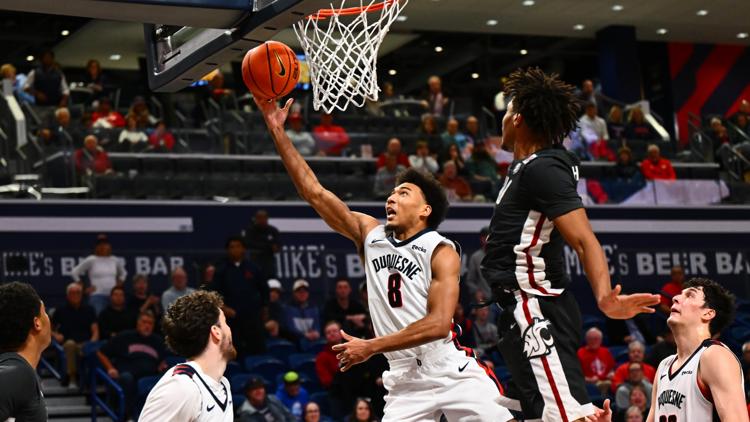
High Point heads to Daytona Beach with the best start in its Division I history, six consecutive double-digit victories, and a defense that is beginning to garner national attention. Standing between the Panthers and a seventh straight victory is a lengthy, physical Duquesne team whose offensive identity is built around attacking the interior. For a High Point program with ambitions beyond the Big South, another opportunity against Atlantic 10 competition awaits.
Back to the Beach
High Point (6–0) vs. Duquesne (5–1)
Tuesday, November 24, 2026
Ocean Center, Daytona Beach, FL
Sunshine Slam
FloSports
Flynn Clayman / Dru Joyce III
High Point returns to familiar surroundings in Daytona Beach, having gone 2–0 at the Ocean Center during last season’s Boardwalk Battle.
The Panthers arrive riding a streak of 21 consecutive victories outside of the NCAA Tournament and having won 29 of their last 30 games when excluding NCAA Tournament contests. Their 6–0 start is the best since the program transitioned to Division I, and every victory this season has come by double digits.
Duquesne enters following its first loss of the season, a 79–61 defeat at the hands of Wyoming on Sunday. The Dukes opened the year with five consecutive victories, including wins over Washington State and Howard.
Tonight marks High Point’s second of three matchups against Atlantic 10 opposition in an 18-day stretch, with George Mason visiting the Qubein Center on December 2.
Different Philosophies, Similar Ambitions
When Dru Joyce III succeeded Keith Dambrot following Duquesne’s 2024 NCAA Tournament appearance, he inherited the responsibility of sustaining a program that had finally broken through after decades of frustration.
Now in his third season, Joyce has reconstructed much of his roster. After improving from 13 wins in his first season to 18 in his second, the former Akron point guard has placed a renewed emphasis on defensive execution, positional size and physicality.
The Dukes aren’t necessarily going to overwhelm opponents with speed or athleticism. Instead, Joyce has assembled a roster featuring bigger guards, versatile international talent and a legitimate interior presence in 6-foot-11 Oregon transfer Ege Demir.
Duquesne’s offensive identity is unmistakable. The Dukes want to get downhill, generate paint touches, draw fouls and utilize their frontcourt as both finishers and facilitators. They rank among the nation’s best at generating free-throw opportunities while committing relatively few fouls themselves.
High Point presents a different proposition.
Through six games, the Panthers have established themselves as one of the more disruptive defensive teams in college basketball. Their ability to generate turnovers, contest shots at multiple levels and deploy waves of athletic personnel has allowed them to remain unbeaten despite inconsistent offensive performances.
Perhaps the most encouraging development for Flynn Clayman’s team is that High Point hasn’t needed to shoot particularly well to win convincingly.
Winning Without the Three
High Point’s 26.5% three-point shooting remains a glaring weakness for a team with championship aspirations. The Panthers have struggled to establish consistency from beyond the arc, with Braden Hausen and Conrad Martinez providing much of the reliable perimeter production.
Yet High Point has compensated by shooting 58.9% on two-point attempts, attacking the offensive glass and consistently getting to the free-throw line.
Thursday’s victory over Montana State was perhaps the best example yet.
The Panthers shot just 5-of-22 from beyond the arc but outrebounded the Bobcats 39–29, outscored them 38–22 in the paint and converted 32-of-39 free throws.
Jason Rivera-Torres scored 16 points without making a field goal. Isaac Garrett scored another 16 while contributing six rebounds, three steals and two blocks. Five Panthers finished in double figures.
High Point made an extraordinary 25-of-26 free throws in the second half.
There are multiple avenues to offensive production for this team, even when the outside shots aren’t falling. Against Duquesne, however, those alternative avenues will be tested by an opponent specifically constructed to defend the interior without fouling.
Where the Teams Stand
| Analytics | High Point | Duquesne |
|---|---|---|
| KenPom | 52 | 146 |
| Bart Torvik | 61 | 139 |
| EvanMiya | 49 | 157 |
| Haslametrics | 61 | 132 |
| KenPom Adj. Offense | 114.6 (77th) | 108.8 (145th) |
| KenPom Adj. Defense | 97.7 (30th) | 107.8 (158th) |
| KenPom Adj. Tempo | 68.9 (184th) | 67.0 (295th) |
The defensive transformation of High Point over the last several seasons continues to be remarkable. While much of the national conversation surrounding the Panthers last season centered on their explosive offense, this year’s team is establishing a considerably different identity.
The offense has plenty of room for improvement, but the defensive foundation is already in place.
1. The Battle for the Paint
Both teams enter tonight preferring to generate offense inside the arc, but Duquesne takes that preference to another level.
More than half of the Dukes’ field-goal attempts come around the rim, where they convert 65.6% of their opportunities. Their three-point attempt rate ranks 329th nationally.
Joyce’s personnel reflects that philosophy. Demir provides a traditional interior target, Kerem Konan can facilitate from multiple areas of the floor, and Yoav Berman and Izaiah Pasha possess the size to attack smaller defenders.
Against Washington State, Konan recorded nine assists, demonstrating his ability to recognize defensive pressure and locate cutters. Twice in the opening minutes of the second half, Konan found Demir for dunks.
High Point cannot afford to become so preoccupied with disrupting the initial ball-handler that it leaves Konan with uncontested opportunities to facilitate from the interior.
| Shot Location | Duquesne Offense | HPU Defense |
|---|---|---|
| At the rim | 65.6% | 54.0% |
| Midrange | 33.3% | 28.0% |
| Three-point range | 30.9% | 28.6% |
Garrett’s defensive versatility, Fletcher’s strength and Rivera-Torres’ length give High Point several options for defending Duquesne’s interior-oriented attack.
The Panthers must remain disciplined when providing help. Konan is too capable a passer to consistently abandon cutters, and Demir is too efficient around the basket to allow uncontested catches.
Forcing Duquesne into uncomfortable midrange attempts or possessions that end with reluctant perimeter shooters would represent a significant victory for High Point’s defense.
2. Make Demir Defend
Standing 6-foot-11 and weighing approximately 275 pounds, Demir presents a considerably different physical challenge than most of the centers High Point has encountered this season.
He is converting 71.4% of his two-point attempts and possesses a block rate of 11.2%, ranking 29th nationally.
His ability to stay on the floor, however, has been an issue.
| Opponent | Second Personal Foul | Third Personal Foul |
|---|---|---|
| Washington State | 8:17, first half | 14:56, second half |
| Howard | 6:58, first half | 17:13, second half |
Duquesne has been extremely conservative with players in first-half foul trouble. Taking Demir out of the equation for extended stretches would alter the complexion of the Dukes’ defense.
Clayman has emphasized the importance of his guards driving with the intention of scoring rather than entering the paint already looking to pass. That approach should carry over into tonight’s matchup.
CJ Brown, Rivera-Torres and Trey Pearson need to make Demir defend repeated actions, whether through downhill drives, ball screens or forcing him to rotate away from Garrett.
Simply challenging Demir at the rim isn’t necessarily the answer. Drawing him away from the basket, attacking his recovery and utilizing Garrett as a rolling or cutting threat could create considerably more favorable opportunities.
Duquesne’s defensive free-throw rate ranks 31st nationally, while High Point’s offensive free-throw rate ranks 49th.
Something will have to give.
3. Disrupt the Facilitators
Duquesne’s roster construction has placed an emphasis on having multiple players capable of initiating offense rather than relying entirely on a traditional point guard.
Berman handled significant playmaking responsibilities at Queens. Pasha was an accomplished creator at Delaware. Konan has emerged as a legitimate frontcourt facilitator, while Arness Lawson continues to develop his responsibilities at the point.
The versatility is valuable, but Duquesne has struggled to consistently protect the basketball.
The Dukes committed 10 first-half turnovers against Washington State, including four over the final two minutes. Against Howard, passing turnovers contributed to a scoring drought lasting more than seven minutes. Wyoming repeatedly capitalized on errant passes to create separation.
Duquesne’s offensive turnover rate of 18.5% ranks 215th nationally.
High Point’s defensive turnover rate of 23.6% ranks 22nd.
Rivera-Torres and Garrett have been particularly effective at disrupting passing lanes, combining length, anticipation and the ability to turn defensive plays into immediate offensive opportunities.
Duquesne has several capable passers, but its collective ball security has not matched its individual playmaking talent.
The Panthers should look to pressure entry passes, deny comfortable catches and force the Dukes’ bigger ball-handlers to change direction. Konan receiving the ball comfortably at the elbow is a substantially different proposition from Konan being forced to initiate offense several feet beyond the three-point line.
4. Can High Point Exploit Duquesne’s Perimeter Defense?
There may not be a better opportunity for High Point’s perimeter shooting to get back on track.
Duquesne enters allowing Division I opponents to shoot 41.9% from beyond the arc, ranking 355th nationally.
Three opponents have already reached double figures in made three-pointers against the Dukes.
13/26 · 50.0%
12/27 · 44.4%
11/25 · 44.0%
5/16 · 31.3%
Some of that is undoubtedly early-season shooting variance. Joyce has maintained that his team contested many of Purdue Fort Wayne’s attempts and has emphasized limiting opposing three-point volume.
Nevertheless, opponents have repeatedly found success from the perimeter.
Duquesne’s interior-oriented defensive personnel could be particularly susceptible to High Point’s ability to penetrate, collapse the defense and relocate shooters.
Hausen will be especially important. His early shooting against both Saint Louis and Montana State demonstrated how quickly he can change the complexion of a game.
High Point doesn’t need to abandon its successful interior approach in pursuit of a perimeter breakthrough. It does, however, need to capitalize on the open opportunities that Duquesne’s defensive priorities could create.
5. Win the Possession Battle
For all of Duquesne’s size, the Dukes haven’t been particularly effective at consistently controlling the defensive glass.
Wyoming collected 16 offensive rebounds on Sunday, repeatedly extending possessions and preventing Duquesne from generating any sustained comeback momentum.
High Point enters with an offensive rebounding rate of 36.8%, ranking 73rd nationally. That figure climbed to 42.4% against Montana State.
Garrett, Fletcher and Frankquon Sherman are all capable of punishing opponents on the offensive glass, but the contributions of High Point’s guards and wings shouldn’t be overlooked. Brown alone collected four offensive rebounds against Montana State.
The Panthers’ ability to generate additional possessions is especially important given their inconsistent shooting.
| Four Factors | HPU Offense | Duquesne Defense |
|---|---|---|
| Effective FG% | 51.3% | 53.3% allowed |
| Turnover rate | 18.8% | 20.1% forced |
| Offensive rebound rate | 36.8% | 32.1% allowed |
| Free-throw rate | 47.6 | 26.4 allowed |
| Four Factors | Duquesne Offense | HPU Defense |
|---|---|---|
| Effective FG% | 53.8% | 44.8% allowed |
| Turnover rate | 18.5% | 23.6% forced |
| Offensive rebound rate | 30.8% | 30.6% allowed |
| Free-throw rate | 52.0 | 32.6 allowed |
Duquesne’s size might suggest an inherent advantage on the glass, but High Point has been the more productive offensive rebounding team.
The Panthers need to capitalize on that advantage while remaining conscious of Konan and Demir at the opposite end.
Against Wyoming, Duquesne’s first eight second-half points came entirely from offensive rebound putbacks by those two players.
Defending the initial shot is only part of the assignment.
6. Depth, Tempo and the Final Eight Minutes
Despite its reputation as an aggressive, fast-paced team, High Point’s adjusted tempo currently ranks near the middle of Division I.
The Panthers’ pace is often dictated by their defensive success rather than an insistence on playing quickly on every possession.
Duquesne has actually been quite effective at limiting opposing transition opportunities, allowing just 8% of possessions to occur in transition, ranking 22nd nationally.
The Dukes are comfortable playing in the half court, where their size and physicality become more pronounced.
High Point needs to create opportunities to run rather than simply trying to force the pace.
There’s also a considerable difference in how the two teams distribute minutes.
38.2%
28.5%
25%
50%
75%
100%
Konan and Berman have shouldered substantial workloads for the Dukes, playing 87.5% and 81.5% of available minutes against Division I opposition, respectively.
High Point has had four full days between games. Duquesne has had one.
The return of Fletcher and Pearson against Montana State further strengthens Clayman’s ability to maintain defensive intensity throughout the game.
Duquesne has shown an ability to execute in close games, particularly against Washington State and Howard, but High Point’s depth and preparation time could become increasingly advantageous as tonight’s contest progresses.
High Point’s best start in Division I program history, with every victory coming by double digits.
The Panthers have outscored their first six opponents by a combined 91 points.
High Point ranks eighth nationally in steal percentage, with disruptive defenders throughout the rotation.
The Dukes rank 355th nationally in opponent three-point percentage. Can High Point finally capitalize from deep?
High Point’s extraordinary second-half performance at the charity stripe against Montana State.
The Dukes rank 15th nationally in the percentage of field-goal attempts coming around the basket.
Fletcher has converted 15 of his 17 attempts inside the arc, ranking sixth nationally.
The Cowboys recovered more than half of their available offensive rebounds against Duquesne.
Duquesne went more than seven minutes without scoring in the first half against Howard.
High Point recorded its lowest offensive turnover rate of the season against Montana State.
High Point’s Offensive Turnover Rate
19.7%
23.6%
19.0%
18.6%
17.7%
14.3%
5%
10%
15%
20%
25%
The Panthers’ ball security has improved in each of their last four games. With the offense still finding its rhythm, ensuring possessions end with shot attempts rather than turnovers is an encouraging development.
A Common Opponent
Both teams have already faced Washington State this season, albeit with considerably different experiences.
| Washington State | High Point | Duquesne |
|---|---|---|
| Points scored | 83 | 72 |
| Points allowed | 71 | 71 |
| Margin of victory | +12 | +1 |
| Location | Home | Home |
Duquesne trailed Washington State by nine at halftime and by as many as 11 early in the second half before rallying behind Konan’s playmaking and an improved defensive effort.
While comparative scores are hardly definitive indicators of future results, High Point has demonstrated a greater ability to create and maintain separation against its opposition.
Kerem Konan — The Offensive Connector
Konan might be the most important player in Duquesne’s offensive structure.
The Turkish forward arrived from Creighton after playing a relatively modest role but has quickly emerged as one of Joyce’s most indispensable pieces.
His combination of strength, rebounding, passing and finishing allows Duquesne to operate through the frontcourt without sacrificing offensive creativity. He recorded nine assists against Washington State and has shown a willingness to make the extra pass rather than force his own offense.
Konan is also capable of stepping outside, having converted four of his nine three-point attempts against Division I competition.
His biggest offensive weakness has been free-throw shooting, where he’s converted just 14-of-27 attempts.
Yoav Berman — The Versatile Creator
High Point fans familiar with Queens basketball should recognize Berman.
The Israeli guard helped the Royals reach their first Division I NCAA Tournament appearance last season, averaging 12.3 points, 3.9 rebounds and 3.6 assists.
Berman brings legitimate positional versatility, capable of initiating the offense, attacking smaller guards and playing away from the basketball.
He’s an efficient interior scorer and dependable free-throw shooter who generally does a good job of balancing scoring and playmaking responsibilities.
At 6-foot-6 and 220 pounds, Berman is particularly dangerous when opponents defend him with smaller guards.
Ege Demir — The Interior Anchor
Demir provides the physical presence around which Duquesne’s defensive identity is constructed.
The Nigerian-born center possesses professional playing experience in Turkey and spent last season at Oregon, where injuries limited his opportunities.
His combination of size, strength and length makes him a legitimate deterrent around the basket. He recorded six blocks to accompany 12 points against Howard.
Offensively, Demir is most effective as a finisher. He’s converted all eight of his dunk attempts against Division I competition this season and is capable of generating additional opportunities on the offensive glass.
He’s less comfortable when asked to create away from the basket, and his turnover rate reflects some of those limitations.
Josh Smith — The Sixth Man
The reigning ASUN Sixth Man of the Year gives Duquesne something its starting lineup occasionally lacks: an aggressive, perimeter-oriented scoring threat.
Smith averaged 16.2 points last season at West Georgia and has continued to provide efficient production in a reserve role.
He’s capable of creating his own shot, attacking closeouts and drawing fouls. His 7.6 fouls drawn per 40 minutes ranks among the nation’s best.
When Duquesne experiences extended offensive struggles, Smith is one of the players most capable of providing an immediate spark.
Izaiah Pasha — The Big-Bodied Guard
The former CAA Rookie of the Year averaged 11.9 points and 3.9 assists at Delaware before transferring to Virginia Tech.
Pasha brings another sizable ball-handler to a roster constructed around positional versatility. He has the strength to absorb contact and the ability to facilitate without needing to dominate possession.
His outside shooting has been encouraging in a limited sample, although he’s struggled to finish consistently inside the arc this season.
Arness Lawson — The Defensive Disruptor
After redshirting last season, Lawson has quickly earned Joyce’s trust through his defensive activity.
He’s frequently tasked with defending the opponent’s most dangerous perimeter creator and possesses the quickness and active hands to disrupt opposing guards.
His offensive game remains a work in progress. Lawson has yet to convert a three-pointer in seven attempts against Division I competition, and he committed four turnovers against Wyoming.
Nevertheless, his ability to generate defensive pressure and attack the basket makes him an important component of Duquesne’s starting lineup.
The Supporting Cast
Jake DiMichele — A remaining member of Duquesne’s 2024 NCAA Tournament team, DiMichele provides experience and secondary scoring. He showed his value with several second-half baskets against Wyoming.
Stephen Olowoniyi — An athletic 6-foot-8 frontcourt option who previously averaged 13.9 points and 6.8 rebounds at Southern Indiana. He’s capable of providing physicality around the basket but has struggled with foul trouble.
Jackson Williams — A freshman guard who provides additional ball-handling and developmental upside.
Brandon Hall — An experienced perimeter defender whose value extends beyond his offensive production.
Frederik Jellum — A frontcourt option with perimeter shooting potential who returned to action against Wyoming. His role remains uncertain as he works his way back into the rotation.
Individual season statistics above are against Division I competition.
Isaac Garrett vs. Ege Demir
Mobility vs. Mass
Garrett is giving up considerable size, but his mobility and versatility could present problems for Demir.
Garrett’s 132.4 offensive rating, low turnover rate and ability to finish around the rim make him one of High Point’s most efficient offensive pieces. His defensive production has been equally impressive, with a steal percentage of 5.8% ranking 19th nationally.
Rather than allowing Demir to establish himself in a traditional battle between centers, High Point should utilize Garrett’s ability to move, screen, cut and defend multiple areas of the floor.
If Garrett can make Demir uncomfortable defensively while preventing him from establishing deep positioning offensively, High Point will have neutralized one of Duquesne’s most significant advantages.
Cam’Ron Fletcher vs. Kerem Konan
Physicality vs. Versatility
Konan’s ability to score, rebound and facilitate makes him a challenging defensive assignment.
Fletcher, however, possesses the physical strength and athleticism to match Konan in ways many opponents cannot.
The preseason Big South Player of the Year has been extraordinarily efficient inside the arc and has collected 29.4% of available defensive rebounds while on the floor, ranking 15th nationally.
His ability to finish defensive possessions and limit Konan’s opportunities to generate second-chance points could be as important as his offensive contributions.
Jason Rivera-Torres vs. Yoav Berman
Two-Way Disruption vs. Positional Playmaking
Rivera-Torres has quickly become one of the most impactful players in High Point’s rotation.
His ability to influence games without scoring from the field was evident against Montana State, where he complemented his 16 free throws with six rebounds, four assists and three blocks.
His steal rate ranks among the nation’s best, and his length allows him to disrupt opponents at multiple levels.
Berman is accustomed to using his size to create advantages against opposing guards. Rivera-Torres represents a considerably different defensive challenge.
If Berman is unable to establish favorable driving angles or comfortably facilitate against High Point’s length, Duquesne’s half-court offense could struggle to maintain its rhythm.
CJ Brown vs. Arness Lawson
The Engine vs. The Disruptor
Brown has assumed an enormous share of High Point’s offensive responsibilities, posting a usage rate of 34.4%, ranking 12th nationally.
While his efficiency and ball security remain areas for improvement, his ability to penetrate defenses and create opportunities for others is central to High Point’s offensive structure.
Lawson’s defensive quickness makes him a particularly interesting opponent for Brown.
Brown cannot allow Lawson to dictate his tempo or force him into careless turnovers. He must also find the appropriate balance between attacking Demir and creating opportunities for teammates when Duquesne’s interior defense collapses.
With Pearson back in the rotation, Clayman has another option capable of maintaining downhill pressure when Brown needs a breather.
Braden Hausen vs. Duquesne’s Perimeter Defense
The Potential Game-Breaker
Perhaps no individual matchup possesses greater potential to turn a competitive game into a comfortable High Point victory.
Hausen is shooting 38.7% from beyond the arc for a team that has otherwise struggled considerably from three.
Duquesne has repeatedly surrendered productive perimeter performances while prioritizing interior protection.
An early flurry from Hausen would force the Dukes to extend their defense, opening driving lanes for Brown and Rivera-Torres while creating additional space for Fletcher and Garrett.
If High Point can pair its existing interior production with consistent perimeter shooting, Duquesne could find itself without a particularly attractive defensive alternative.
Another Opportunity to Establish the Standard
High Point’s ambitions are no secret.
The program has invested heavily in establishing itself beyond the confines of the Big South, and the Atlantic 10 represents a natural aspirational destination given its competitive standard, institutional profile and geographic footprint.
Conference realignment is ultimately decided away from the basketball court, but High Point has an opportunity this season to demonstrate that it belongs in conversations with those programs on the floor.
The Panthers have already gone into Saint Louis and defeated the preseason Atlantic 10 favorite in a building where visiting teams rarely win.
Duquesne presents a different test.
The Dukes possess considerably more interior size than High Point, multiple capable facilitators and a defensive philosophy that could neutralize some of the Panthers’ preferred methods of generating offense.
Their ability to defend without fouling, limit transition opportunities and operate through their frontcourt gives them a realistic path toward keeping this game competitive.
However, Duquesne’s weaknesses align particularly well with High Point’s strengths.
The Dukes have struggled with turnovers, surrendered too many offensive rebounds and experienced extended stretches of offensive inactivity. The Panthers are equipped to exploit all three.
The biggest question remains whether High Point can take advantage of Duquesne’s vulnerable perimeter defense. Even a modest improvement in three-point efficiency could substantially raise the Panthers’ offensive ceiling tonight.
Expect Duquesne to make High Point work for its interior opportunities and keep the game competitive for stretches. As the game progresses, however, High Point’s defensive pressure, superior depth, offensive rebounding and fresher legs should allow the Panthers to create separation.
High Point by 14
144
Seven games. Seven victories. Another Atlantic 10 opponent.
The Panthers have an opportunity to continue demonstrating that their aspirations are supported by considerably more than ambition.